Transcription and Translation
The central dogma of Biology is DNA –> RNA –> protein. But how do we get there? This is where the processes of transcription and translation come into play. Transcription is the process by where RNA is synthesized from a DNA template and translation is the process by where protein is made from the RNA (mRNA) template. Let’s discuss in detail, how each process works.
Transcription
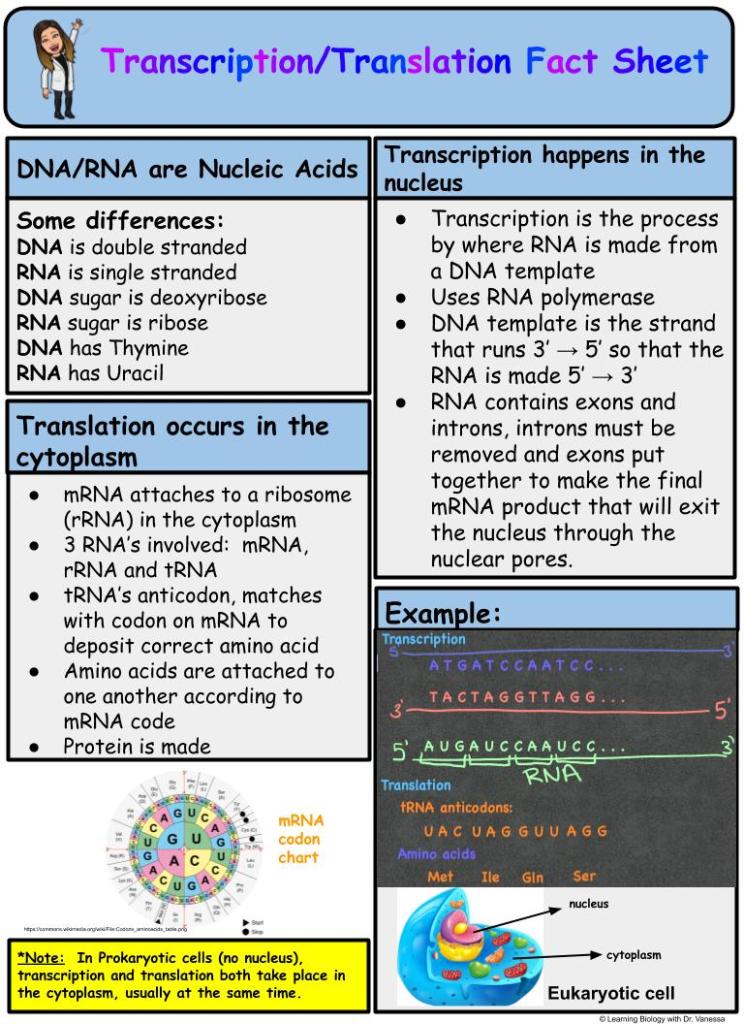
In Eukaryotic cells, transcription occurs in the nucleus. DNA is double stranded, with one strand running 5’ –> 3’ and the other running parallel at 3’ –> 5’. Transcription or RNA synthesis, involves the DNA strand running 3’ –> 5’ or the DNA template. RNA polymerase, an enzyme needed for this process, binds to the promotor region of the DNA. As RNA polymerase moves down and opens up the DNA, it adds nucleotides based on the DNA code. The nucleotides that are added are base pairs to the DNA template. The RNA polymerase will move down until it encounters a stop codon, at which point the RNA will be released. The RNA that is released is actually pre-mRNA. It contains both introns and exons. In order to be properly read and turned into protein, the introns need to be spliced out by RNA splicing and the exons put together. Once this process happens, the mature mRNA, will exit the nucleus through the nuclear pores and enter into the cytoplasm.
Translation
Once the mRNA is in the cytoplasm, it can bind to a ribosome where the process of translation will take place. In order for translation to occur, there are three RNA’s needed. These are the ribosome or rRNA, the mRNA which binds to the ribosomes and just came from the nucleus, and tRNA. mRNA is read in triplets or codons, so every three nucleotides. tRNA has anticodons, so three nucleotides that will match with the codons on the mRNA. For each anticodon tRNA has, it carries a specific amino acid. So again, the amino acid that tRNA carries is based on its anticodon. This allows the proteins that each mRNA codes for to be made the same way every time. tRNA travels to the ribosome, binds its anticodon to mRNAs codon and deposits its amino acid, this will continue until the entire amino acid chain (polypeptide) is made and the tRNA reaches a stop codon. (This process is much more specific and I have explained it thoroughly in the video I linked below) At this point, the protein will be released. It can be folded, have posttranslational modifications made to it, be chaperoned somewhere. At this point the protein is made and what happens next just really depends on its function.
*NOTE: In prokaryotic cells (cells which have no nucleus), transcription and translation both occur in the cytoplasm, usually at the same time.
Here is a video that I made on this topic. It goes into much more detail so that you can really grasp this concept:
Here is a study guide / fun fact sheet I made on this topic:
Let me know what you think. Should I make more fact sheets? Do you like the video? Comment below and let me know your thoughts or if you have any questions.
 Learning Biology with Dr. Vanessa, LLC