Breathing is natural phenomenon. We don’t think about it, but it happens. If it didn’t, we wouldn’t be here. In order to breath, we take a breath in by inhalation and we breathe out by exhalation. Our respiratory system plays a vital role in our body.
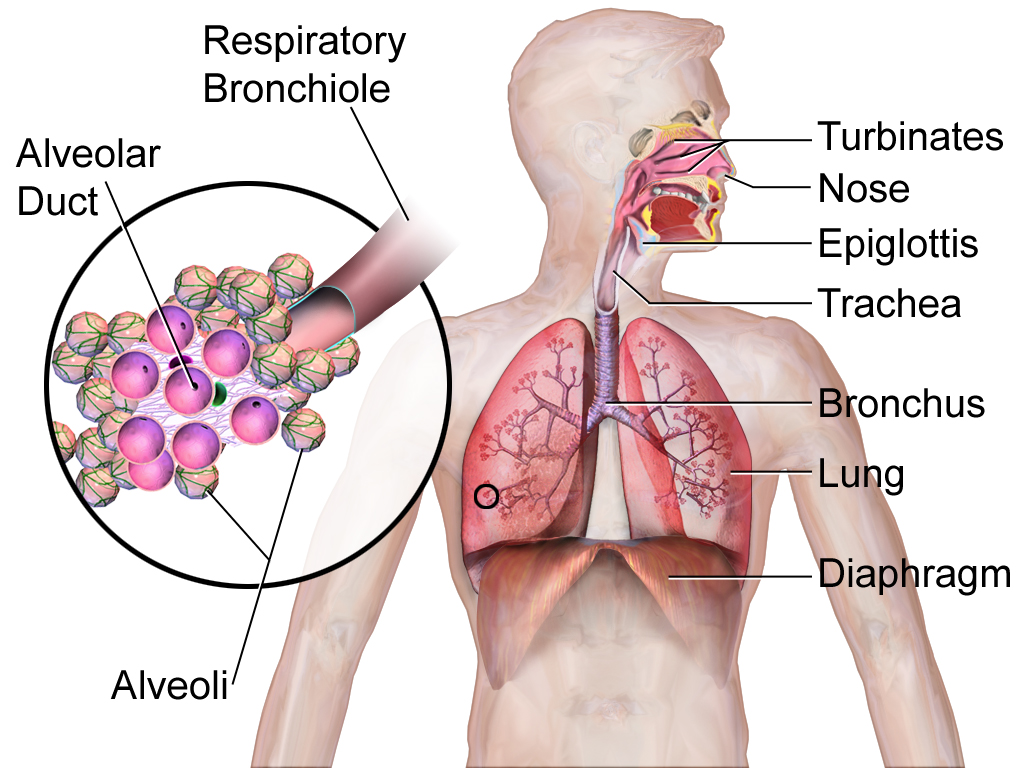
Inhalation – is the movement of the air from the external environment, through the airways and into the alveoli.
Note: In order for air to move into the lungs, alveolar pressure (pressure within the alveoli) must be LOWER than the atmospheric pressure (outside air).
BOYLE’s LAW – states that pressure and volume of a gas are inversely proportional in a closed space.
Note: this is important because the space has to be closed or this law does not apply. Therefore, if volume decreases then the pressure increases proportionally and vice versa.
How does inhalation happen?
Inhalation is an active process – which means, it requires muscular contraction.
Contraction of muscles brings the diaphragm down and the expands the chest to increase volume in the thoracic activity; therefore, decreasing pressure.
Note: Inhalation can then occur because alveolar pressure would be LOWER than the atmospheric pressure.
Muscles involved in inhalation
- Diaphragm
- External intercostals
How does exhalation happen?
Exhalation is normally a passive process. Muscles relax rather than contract.
Note: In order to exhale, alveolar pressure must be GREATER than atmospheric pressure.
Three factors that can affect the airflow
- Surface tension of alveolar fluid.
- Type II alveolar cells produce surfactant.
- Surfactant – reduces surface tension of alveolar fluid and helps keep alveoli from collapsing.
- Lung Compliance
- The lungs naturally have a high compliance.
- This high compliance means that the lung tissue can easily expand.
- Airway Resistance
- The larger the diameter of the airway, the less resistance there is.
There are different things that can affect how we breathe. For example: when we are sick or when our lungs are filled with fluid and this creates pressure differences and barriers for airflow.
If you follow my YouTube Channel, this follows my video on “How Do We Breathe?” You can watch it below and use these blog notes to follow along. Or you can use these notes on their own! You could also watch the video first and then read through the notes to see how much you remembered! If you like my content, please make sure to share and subscribe so I can continue to bring these videos to you!
 Learning Biology with Dr. Vanessa, LLC