Every house you see has its own structure. You can’t build a house without a wooden framework, right? This framework holds up our homes. Just like this, our body also needs these frameworks for support and strength and we call them bones. The skeleton is what holds us together and it allows us to move our body.

What is a Skeletal System?
- Composed of bones (cartilage and ligaments)
- Cartilage is the precursor for most bones. It also is found on the ends of bones to keep bones from rubbing against each other.
- Ligaments attach bone to bone.
- Tendons attach muscle to bone.
Note: These attachments of bone to bone and muscles to bone allows your skeleton to move freely.
Functions of the Skeleton
- Protection
- Support
- Movement
- Electrolyte balance
- Acid-base balance
- Blood movement
Bone Tissue aka Osseous Tissue
- Connective tissue with a matrix hardened by calcium phosphate and other minerals.
- Even though bone is hardened, it is a living tissue.
Bone Shapes
- Long bone Ex: Humerus, radius, ulna, metacarpals, phalanges, femur, tibia, fibula
- Short bone EX: Bones of the wrist, carpals and tarsals in the ankle.
- Flat bones EX: Cranial bones, ribs, sternum, scapula, and hip bones.
- Irregular bones EX: Vertebrae, and some skull bones.
When we take a closer look at the features of our bones, we’ll notice that the bone is made up of two different types of the bone:
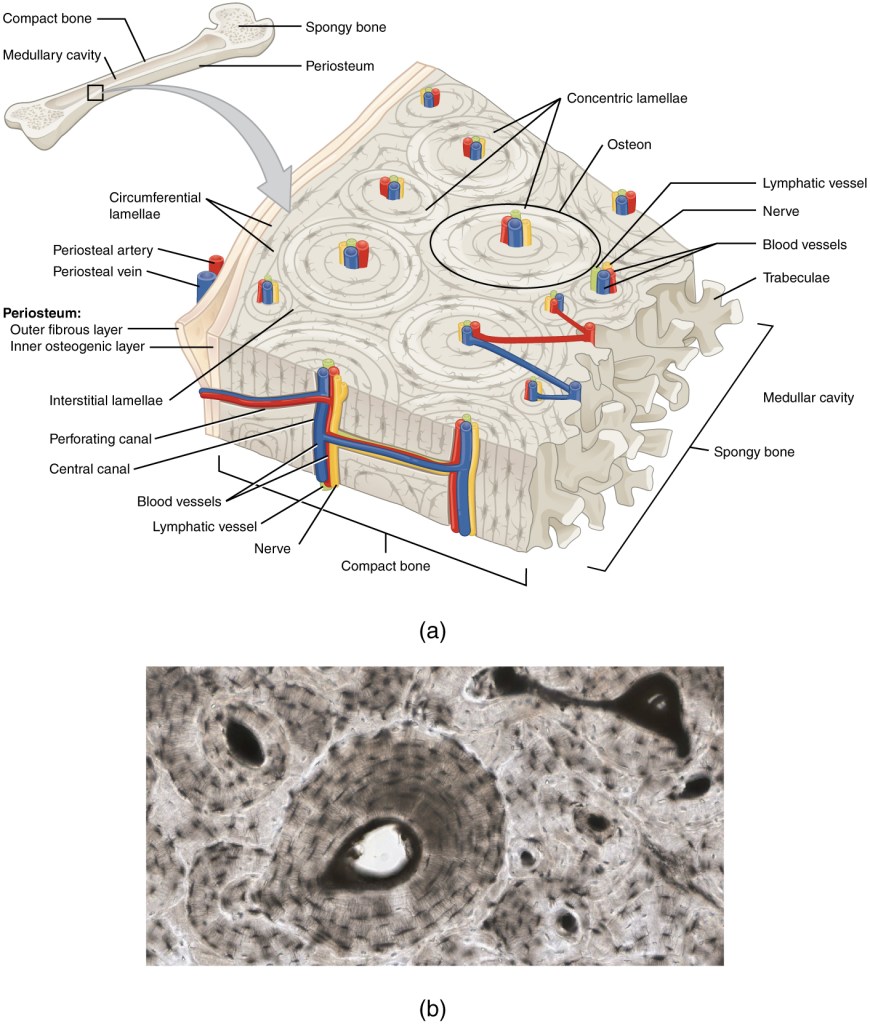
- Compact bone – is a very dense osseous tissue. It covers the surface of most bones.
- Spongy bone – is loosely organized tissue. It makes the bone lighter.
- Osteogenic cell is a stem cell that gives rise to osteoblasts.
- Osteoblasts are bone-forming cells. These are non-mitotic.
- Osteocytes are mature bone cells that maintain bone tissue.
- Osteoclasts function in resorption and break down of bone extracellular matrix.
Note: Bone Development is a lifelong process.
Ossification – formation of bone tissue.
- Formation of bone in the embryo.
- Growth of bones until adulthood.
- Remodelling of bone
- Repair of fractures
Two types of ossification:
- Intramembranous ossification
- Endochondral ossification
For a video version of this, with more details, be sure to watch my lecture on the Introduction to the Skeletal System below.
 Learning Biology with Dr. Vanessa, LLC