Many people have died from antibiotic resistance. Mainly because of the overuse or misuse of antibiotics over the years. Our society is alarmed by this crisis.
According to the CDC more than 2.8 million antibiotic-resistant infections occur in the U.S. each year, resulting in about 35,000 deaths.
What is Antibiotic resistance?
It happens when your medicine or drug can’t fight the bacteria or germs within your body.
It hinders the treatment of infections in our bodies. This causes our bodies to feel weak rather than being well.
The causes of antibiotic resistance:
Antibiotics are getting misuse and overuse.
Poor healthcare services.
Limited access to immediate and adequate disease treatments.
Poor sanitation and hygiene.
How does antibiotic resistance develop?
Antibiotics are mainly used to help our sick body fight bacterial infections.
Some of these bacterias inside our body are good at defending themselves making it hard to kill, as they gain a mutation. This is what we now call antibiotic resistance.
The antibiotic resistance can pass to new bacteria as the bacteria multiply and can transfer to other bacteria through horizontal gene transfer.
How to slow down antibiotic resistance?
Use antibiotics only when prescribed by doctors: and only when you have a bacterial infection and not for the common cold or any other viral infection.
If you are on antibiotics, complete the entire course of antibiotics prescribed by your doctor.
Never use or share leftover antibiotics. Do not self medicate.
Prepare healthy and clean food.
Observe proper hygiene. For example, you should wash your hands properly.
Anyone can get infected with antibiotic resistance regardless of age. Infections that are caused by these germs are very difficult and almost impossible to treat. While antibiotics are valuable because they let us cure untreatable diseases, as time went on, we forgot how to use them properly, reducing their effectiveness. We must always use antibiotics wisely for them to be effective.
If you’re interested in learning more, the CDC goes into more detail about how the mechanisms of antibiotic resistance happens: Click here
The CDC website above also has a few downloadable PDFs with great information. I’m putting my favorite one here, but check out the page above for more!
How Antibiotic Resistance Moves Directly Germ to Germ
The body is made up of cells. Inside the cell, we can find nucleic acid. Nucleic acids are composed of what we call nucleotides. These nucleotides are the monomers of nucleic acids. They consist of several different things like sugar, phosphate and a nitrogenous base. The best-known nucleotide itself is ATP (Adenosine Triphosphate). ATP is vital because it is the energy currency of the cell.
To better understand mRNA let us discuss DNA and RNA. These two have a vital role in producing mRNA.
Nucleic acids have two main classes: DNA and RNA. Let us break down the difference between the two.
DNA or deoxyribonucleic acid
RNA or ribonucleic acid
– is a double helical structure that contains the hereditary material in living organisms. -DNA is much bigger than RNA. – contains deoxyribose as its sugar. -consists of four nitrogenous bases: Adenine (A), Cytosine (C), Guanine (G), and Thymine (T).
-is a single helix. – RNA is much smaller than DNA. – contains ribose as its sugar. – Also consists of four nitrogenous bases. Instead of Thymine, RNA has Uracil (U), Adenine (A), Cytosine (C), and Guanine (G).
Note: DNA has genetic information codes for everything discovered in a given organism and it can make a copy of itself.
Let’s take a look at the cell.
At the center of the cell, we can see the nucleus. We can find the DNA inside the nucleus. Because the DNA is too large to leave the nucleus of the cell, it will always remain there.
Replication is the process by which DNA copies itself. DNA can also direct the synthesis of RNA in the nucleus, through a process known as transcription.
Transcription is the process of creating RNA from DNA. Transcription, like DNA replication, occurs within the cell’s nucleus. Once RNA is synthesized from DNA, it can exit the nucleus via nuclear pores and enter the cytoplasm. Protein synthesis can take place here, on a ribosome. The translation is a process of converting RNA to protein.
These three processes are known as biology’s central dogma, in which we take instructions from DNA and convert them into a functional product by going from DNA to RNA to protein.
To better understand the differences between such three phases, refer to the table below:
Replication
Transcription
Translation
– DNA replicates itself. – This process occurs in the nucleus. – It generates two identical DNA strands. – This process is needed only when the cell replicates.
– The synthesis of RNA from DNA. – Process occurs in the nucleus. – mRNA is produced and leaves the nucleus.
– It is responsible for the conversion of mRNA to protein. – This process occurs in the cytoplasm on a ribosome. Ribosomes can be free floating or attached to the rough endoplasmic reticulum. – Produces proteins.
What is mRNA?
mRNA is an essential component in making proteins. Without mRNA, we would not have the code to make the specific proteins that are found within the body.
Where does mRNA come from?
The RNA that makes the protein during the process of translation is mRNA. When RNA is transcribed from DNA to make protein, only a small portion of the DNA is transcribed. Therefore, RNA products are much smaller than DNA itself. And that’s how RNA can leave the cell’s nucleus.
When RNA is first transcribed from DNA it is referred to as pre-mRNA or a precursor mRNA. In order for pre-mRNA to become mRNA, it needs to be processed through a series of steps.
In the first step, all the introns have to be removed. Keeping all the exons together. These exons are known as the protein-coding region. The removal of these introns or the splicing that occurs to put these exons together also allow for the diversity that we see within mRNA allows for different proteins to be made. Furthermore, the addition of a five prime capanda three prime poly tail.Once these modifications have been made the mRNA is then now ready to move from the nucleus into the cytoplasm in order for protein synthesis to occur.
Once this mature mRNA leaves the nucleus and enters into the cytoplasm of the cell it will attach to an organelle known as a ribosome (made up of rRNA).
Three sub-units of the ribosome binding sites:
Amino acid site
Polypeptide site
Exit site
The first tRNA molecule is going to come in and bind with Adenine (A), Uracil (U) and Guanine (G). The mRNA will become triplets or referred to as codons. The tRNA has an anticodon match up with the codon of the RNA.
Note: The AUG of the mRNA is the start codon which begins the process of translation, the tRNA is going to come in and bind.
These tRNAs continue to come into the ribosome and build up the amino acid chain, matching amino acids to their respective codons, which creates a polypeptide. Once a stop codon is reached, the amino acid chain or polypeptide chain, will be released from the ribosomes.
There are three different stop codons or termination codons that can be found on the mRNA: UAA, UAG and UGA. These are codons that the tRNA cannot recognize and it allows the release of the protein.
Once the protein is made it can now do its job. A lot of proteins do need post-translational modifications, in which, things will be added onto that protein. The proteins also need to be folded into their proper shape in order to function correctly.
I want to introduce you to a company called Know Yourself. They have some amazing workbooks that cover Anatomy/Physiology, including their Bones of the Body series and The Systems of the Body Adventure Series. I particularly like what this company has to offer. These workbooks, designed for grades 3-5, can be used for younger kids and even adults. They are a great introduction to the organ systems and bones and more! In another blog, I will cover the workbooks more. In this blog, I want to introduce you to another line they have, the Organauts. The organauts are fun little toys that allow you to learn more about the organ systems of the body. You can purchase large models of them or blind boxes or even blind bags which contain keychains of the organauts. Who doesn’t like a surprise??
I love these because they are so well made, colorful and well, just plain cute! If you are interested in purchasing them, you can Click HERE.
*I am an affiliate of the company and do receive a portion of the sale when you use the link above. I appreciate it as I use this to keep my videos and site running, so Thank you!
Use discount code: DRVANESSA10 To receive 10% off on all products by Know Yourself.
You can check out my video here to see me and my kiddos opening some blind boxes and blind bags, aren’t they just adorable?
Every house you see has its own structure. You can’t build a house without a wooden framework, right? This framework holds up our homes. Just like this, our body also needs these frameworks for support and strength and we call them bones. The skeleton is what holds us together and it allows us to move our body.
What is a Skeletal System?
Composed of bones (cartilage and ligaments)
Cartilage is the precursor for most bones. It also is found on the ends of bones to keep bones from rubbing against each other.
Ligaments attach bone to bone.
Tendons attach muscle to bone.
Note: These attachments of bone to bone and muscles to bone allows your skeleton to move freely.
Functions of the Skeleton
Protection
Support
Movement
Electrolyte balance
Acid-base balance
Blood movement
Bone Tissue aka Osseous Tissue
Connective tissue with a matrix hardened by calcium phosphate and other minerals.
Even though bone is hardened, it is a living tissue.
Bone Shapes
Long bone Ex: Humerus, radius, ulna, metacarpals, phalanges, femur, tibia, fibula
Short bone EX: Bones of the wrist, carpals and tarsals in the ankle.
Flat bones EX: Cranial bones, ribs, sternum, scapula, and hip bones.
Irregular bones EX: Vertebrae, and some skull bones.
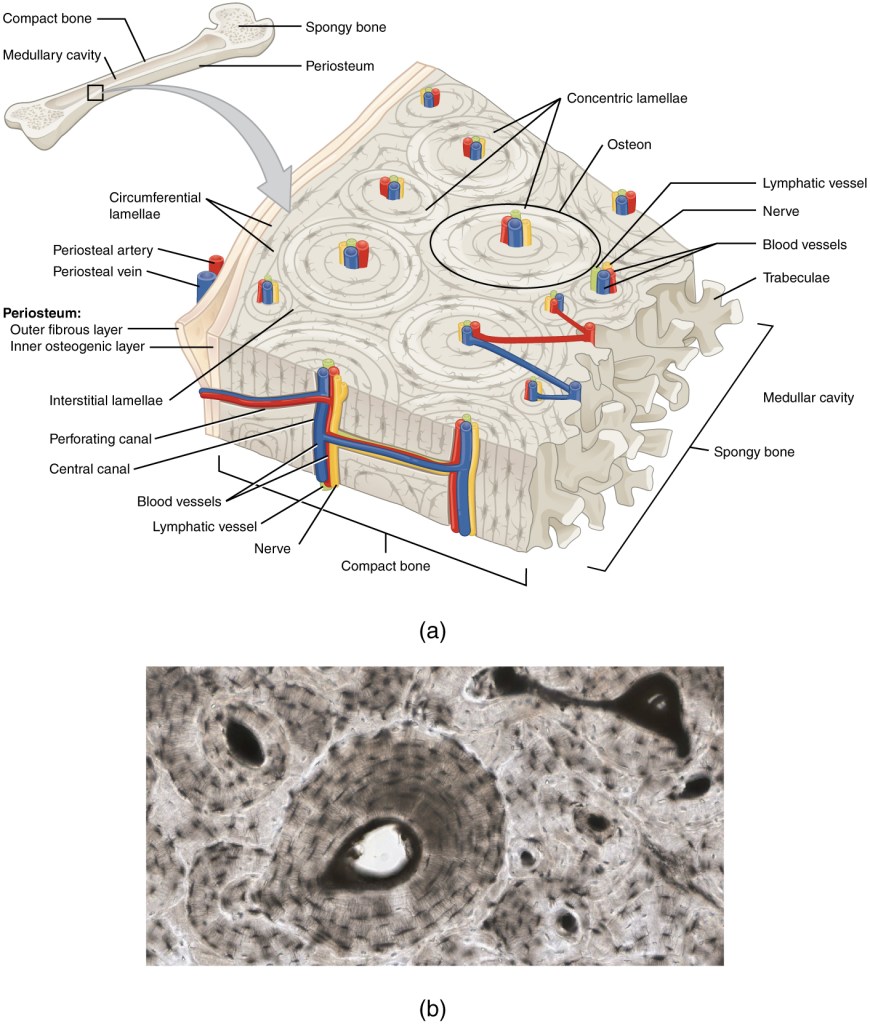
When we take a closer look at the features of our bones, we’ll notice that the bone is made up of two different types of the bone:
Compact bone – is a very dense osseous tissue. It covers the surface of most bones.
Spongy bone – is loosely organized tissue. It makes the bone lighter.
Osteogenic cell is a stem cell that gives rise to osteoblasts.
Osteoblasts are bone-forming cells. These are non-mitotic.
Osteocytes are mature bone cells that maintain bone tissue.
Osteoclasts function in resorption and break down of bone extracellular matrix.
Note: Bone Development is a lifelong process.
Ossification – formation of bone tissue.
Formation of bone in the embryo.
Growth of bones until adulthood.
Remodelling of bone
Repair of fractures
Two types of ossification:
Intramembranous ossification
Endochondral ossification
For a video version of this, with more details, be sure to watch my lecture on the Introduction to the Skeletal System below.
In previous blogs, you have learned how our respiratory system works and how we breathe. Our lungs have a vital role in breathing in and breathing out. This time, we are going to take a look at how gas exchange occurs within the lungs.
Gas Exchange
is the process by which oxygen and carbon dioxide are exchanged between the lungs and bloodstream.
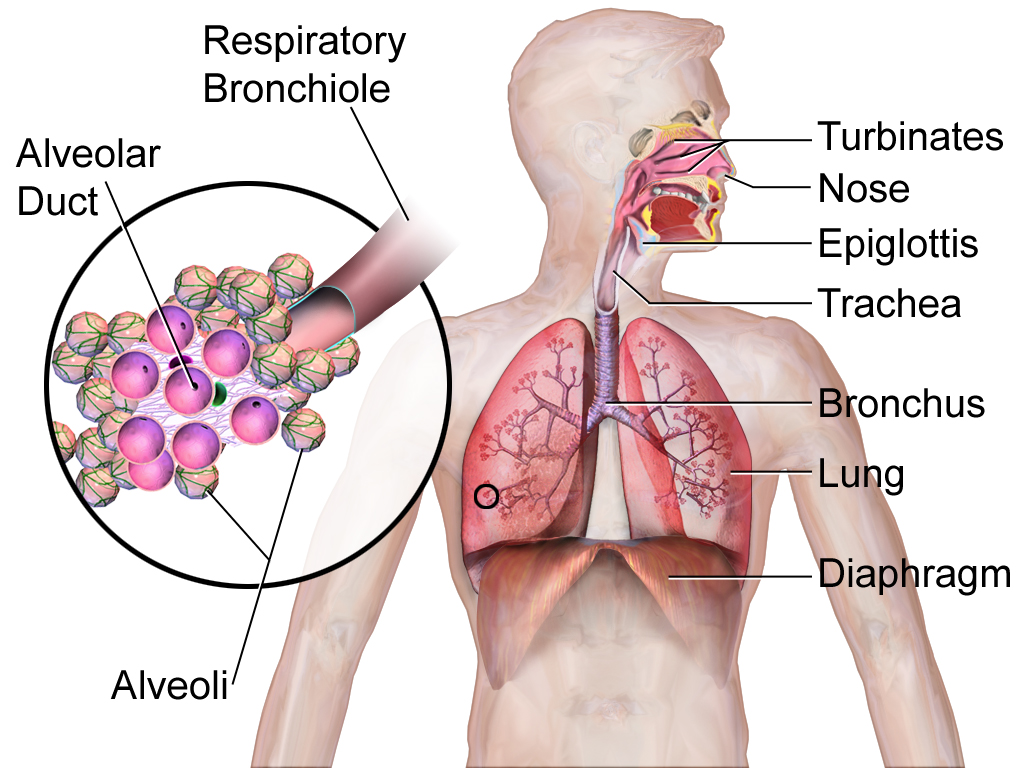
Gas exchange occurs in the respiratory zone which includes the respiratory bronchioles and alveoli.
Recap: The main function of the respiratory system is to consistently supply oxygen to the tissues and to remove carbon dioxide so it does not accumulate.
Gas exchange occurs between the alveoli and the capillaries that surround them. Deoxygenated blood from the right side of the heart enters the lungs via the pulmonary artery and then enters into tiny capillaries within the lungs. The blood in the capillaries will then release carbon dioxide into the lungs to be exhaled and pick up oxygen that has been inhaled. This oxygenated blood then goes back to the left side of the heart to be pumped throughout the body delivering oxygen and nutrient-rich blood to all the tissues.
Diffusion – is the movement of substances from areas of higher concentration to areas of lower concentration.
Note: Air is a mixture of gases like nitrogen, oxygen, water, vapor and carbon dioxide.
The partial pressure of a specific gas is determined by multiplying atmospheric pressure by the percentage of the specific gas in atmospheric gas.
The partial pressure of a gas depends on:
Concentration – the greater the concentration of the gas the greater its partial pressure will be.
Solubility – the more soluble a gas is in a fluid, the less it wants to “escape”.
Example: carbon dioxide is much more soluble in water (blood) than oxygen.
External Gas Exchange
Transfer of oxygen from alveoli to blood.
Transfer of CO2 from blood to alveoli.
Gas Diffusion across pulmonary membrane depends on two main factors:
Partial pressure gradients between alveolar air in the blood.
Health of lung issue.
Note: Majority of oxygencarried in the blood is bound to hemoglobin which is found in the red blood cells.
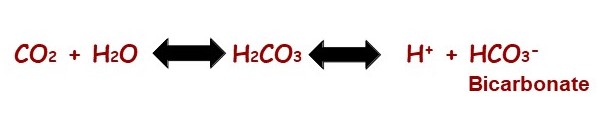
Carbon dioxide is soluble 80%-90% is carried in the blood as bicarbonate.
Recap:
Partial pressure of oxygen, greater in alveoli
Therefore, oxygen can diffuse easily from alveoli to blood.
Partial pressure of carbon dioxide, greater in the capillaries
Therefore, CO2 can easily diffuse from the capillaries to the alveoli.
What are some things that can affect gas exchange?
Membrane thickness – thinner membrane
Membrane surface – less surface area
Pressure differences across the membrane
To see this explained in video format, check out my video on “How does Gas Exchange Occur in the Lungs?“
Breathing is natural phenomenon. We don’t think about it, but it happens. If it didn’t, we wouldn’t be here. In order to breath, we take a breath in by inhalation and we breathe out by exhalation. Our respiratory system plays a vital role in our body.
Inhalation– is the movement of the air from the external environment, through the airways and into the alveoli.
Note: In order for air to move into the lungs, alveolar pressure (pressure within the alveoli) must be LOWER than the atmospheric pressure (outside air).
BOYLE’s LAW – states that pressure and volume of a gas are inversely proportional in a closed space.
Note: this is important because the space has to be closed or this law does not apply. Therefore, if volume decreases then the pressure increases proportionally and vice versa.
How does inhalation happen?
Inhalation is an active process – which means, it requires muscular contraction.
Contraction of muscles brings the diaphragm down and the expands the chest to increase volume in the thoracic activity; therefore, decreasing pressure.
Note: Inhalation can then occur because alveolar pressure would be LOWER than the atmospheric pressure.
Musclesinvolved in inhalation
Diaphragm
External intercostals
How does exhalation happen?
Exhalation is normally a passive process. Muscles relax rather than contract.
Note: In order to exhale, alveolar pressure must be GREATER than atmospheric pressure.
Three factors that can affect the airflow
Surface tension of alveolar fluid.
Type II alveolar cells produce surfactant.
Surfactant – reduces surface tension of alveolar fluid and helps keep alveoli from collapsing.
Lung Compliance
The lungs naturally have a high compliance.
This high compliance means that the lung tissue can easily expand.
Airway Resistance
The larger the diameter of the airway, the less resistance there is.
There are different things that can affect how we breathe. For example: when we are sick or when our lungs are filled with fluid and this creates pressure differences and barriers for airflow.
If you follow my YouTube Channel, this follows my video on “How Do We Breathe?” You can watch it below and use these blog notes to follow along. Or you can use these notes on their own! You could also watch the video first and then read through the notes to see how much you remembered! If you like my content, please make sure to share and subscribe so I can continue to bring these videos to you!
To keep us alive and kicking, we breathe every second, minute, hour with the help of our Respiratory System. Have you ever wondered how this works? I’ll explain thoroughly the functions of the Respiratory System. At the end of this, I’ll share some tips on how to take care of our respiratory system to make sure it is always working at its best.
What is the Respiratory System?
Made up of organs and tissues which allow the body to breathe.
Allows the cells to receive oxygen and release wastes, such as carbon dioxide.
Let’s take a closer look at how the respiratory system is made up and how it’s classified. It is divided into two classifications:
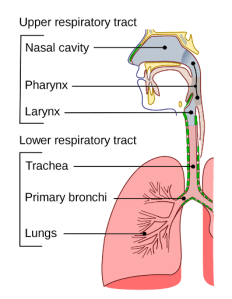
Upper respiratory system – this includes the nose and its structures, pharynx ( oropharynx, nasopharynx and laryngopharynx). Upper respiratory infection- refers to the congestion that occurs in the facial region.
Lower respiratory system – this includes the trachea, bronchi and the lungs. Lower respiratory infection- this infection has now affected the lungs and could lead to pneumonia.
Recap: The respiratory system is split up into two categories: the upper respiratory system which is the nose ,the pharynx and the larynx . Moving down is the lower respiratory system which is the trachea, bronchi and the lungs.
Functionally, the respiratory system is divided into two:
Conducting zone –it is the zone which conducts the air to the lungs.
Respiratory zone –it is the zone which is the site of gas exchange.
Now that you understand the respiratory system and it’s different classification and functionality, let’s talk about the responsibilities of this system.
Main Functions of the Respiratory System
Functions in smell, smell receptors (olfactory receptors).
Functions in sound production (phonation).
Filters inspired air.
Provides oxygen to cells and removes wastes.
Helps to adjust the pH of the body.
Altogether, the respiratory system is a very important and crucial part of our body for us to survive.
How can we keep the Respiratory System healthy?
Avoid exposure to various pollutants. Ex: Smoke (cigarettes/fire), molds
Prevent infection. Ex: Wash your hand, eat healthy
Exercise.
For a video version of this, watch my lecture on the Function of the Respiratory System
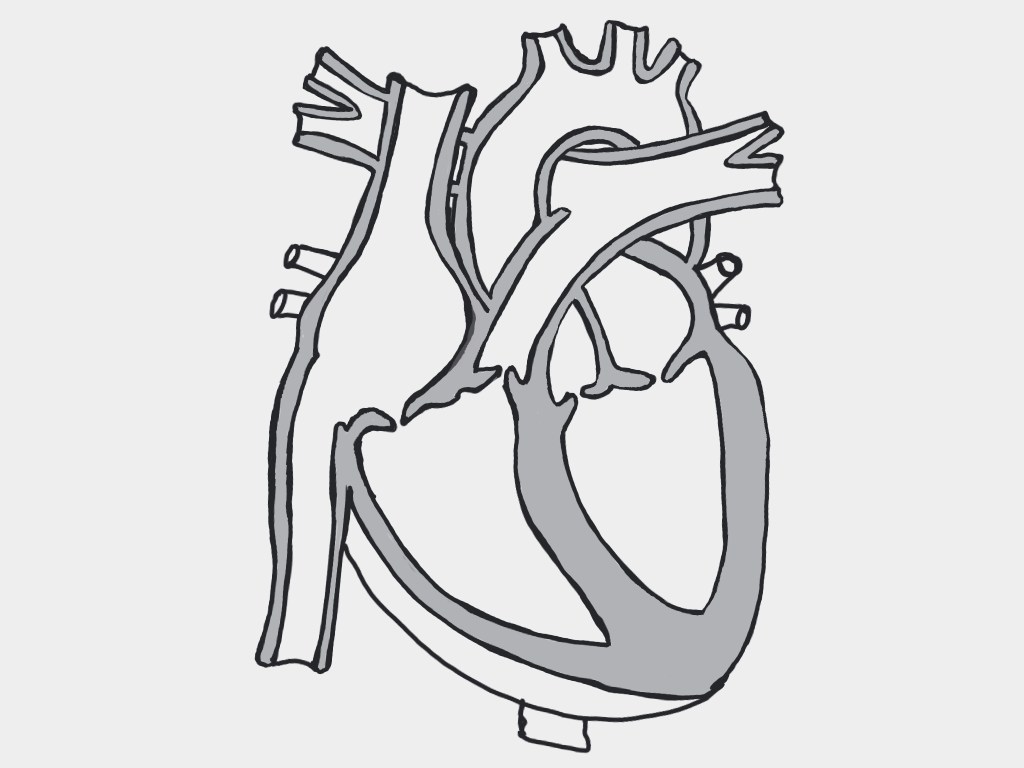
One of the difficult parts of being a professor and teaching a course like Anatomy/Physiology or Biology is finding models that appropriately can be used to enhance the student’s learning. Models are expensive by nature. Some aren’t as good as quality as others. Some just don’t have the amount of info you would like them to have. This is why I wanted to start reviewing models and bring them to you, so you could see first hand, further than a website page, exactly what that model looked like. Today I am reviewing the Axis Scientific 2-Part Deluxe Life-Size Human Heart Anatomy Model. You can view my video review here:
The quick and dirty is that I really do like this model, it is good quality, durable and is labeled with numbers. It has a high quality picture key that is labeled with the parts of the heart that correspond to the numbers on the heart. The heart model also comes apart so that the inside can also be studied, which is absolutely necessary with the heart. It also comes back together with a very strong magnet, not little pieces or hooks that eventually break. I like this feature because it stays together very well. Often times, with other closures, they end up not working and fall all over the lab space.
In order to understand this, we need to talk about smallpox. Small pox holds a unique place in medicine as it was one of the deadliest diseases known to humans, and, to date, is the only human disease to have been eradicated by vaccination. Smallpox would cause body aches, high fevers, sore throat, headache and even difficulty breathing. The worst part was a pus-filled rash that would cover the whole body. Smallpox was a devastating disease, about 3 out of every 10 people which contracted it, died.
Watch my video to find out more about how smallpox paved the way for conventional vaccinations:
Conventional vaccines include: live viruses that have been attenuated (weakened or altered so as not to cause illness); inactivated or killed organisms or viruses; inactivated toxins (for bacterial diseases where toxins generated by the bacteria, and not the bacteria themselves, cause illness); or merely segments of the pathogen (this includes both subunit and conjugate vaccines).
mRNA vaccines utilize mRNA which codes for a specific protein. Once this mRNA is injected into an individual, the cells will take it up and make the protein. This protein is then displayed to the immune system and an immune response is activated against the protein.
*My video above describes in detail the different types of conventional vaccines and how they differ from mRNA vaccines.
Teachers/Professors: Want to use the above video as an assignment in your class? Check out this worksheet I made to go with it! Click on the button to download the worksheet.









 Learning Biology with Dr. Vanessa, LLC
You must be logged in to post a comment.